Near-Infrared Vein Visualisation: How the QV-500 Works
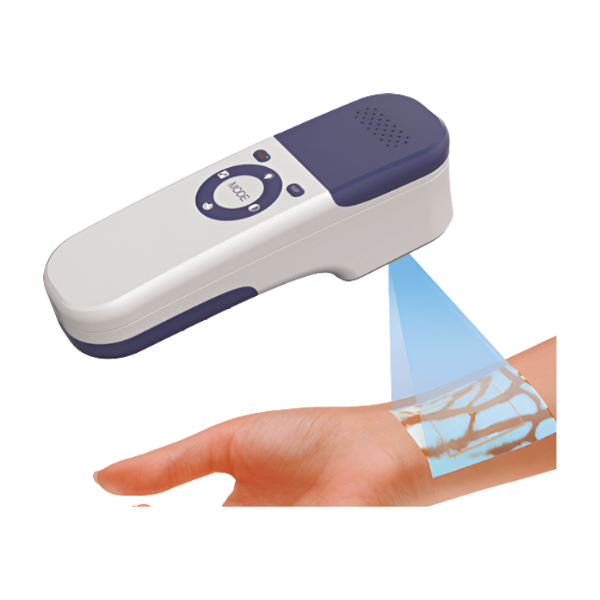
The QV-500 uses near-infrared (NIR) light at wavelengths that are selectively absorbed by haemoglobin in blood and reflected by the surrounding dermal tissue. This differential absorption creates a high-contrast image of the subcutaneous vein network, which the device processes in real time and projects back onto the patient’s skin surface using visible light. The result is a vein map that appears directly over the anatomical location of the veins — allowing the clinician to see exactly where veins are positioned under the skin, in their precise location, without any interpretation required and without looking away from the access site. Detection depth reaches up to 8mm below the skin surface, covering the majority of peripheral veins used for cannulation and venepuncture in clinical settings.
Clinical Benefits for Difficult Venous Access
Failed venepuncture is one of the most common causes of patient discomfort and delayed care across hospital, clinic, and emergency settings. Patients with difficult venous access — including neonates, elderly patients, those with obesity, dark skin pigmentation, oedema, or extensive prior cannulation history — are disproportionately affected by repeated attempts. The QV-500 reduces the number of venepuncture attempts required, shortens procedure time, reduces anxiety among nursing staff managing difficult access cases, and significantly improves the patient experience. It is of particular clinical value in paediatric wards, oncology units, dialysis centres, and emergency departments where difficult venous access is encountered routinely and time-to-access directly affects patient outcomes.
Device Variants and South African Availability
The QV-500 is available in two configurations from Vital Medical: the handheld portable version (VM-VFQV500) for bedside use across ward and clinic environments, and the trolley-mounted version (VM-VFQV500T) which provides stable, hands-free positioning of the device during cannulation procedures, freeing both of the clinician’s hands for the venepuncture itself. Available in South Africa from Vital Medical, the QV-500 is suited to public and private hospitals, day clinics, frail care facilities, oncology day units, renal dialysis centres, and any clinical setting where improving first-attempt cannulation success is a patient safety and workflow priority.
TECHNICAL SPECIFICATIONS TABLE
| Specification | Detail |
|---|---|
| Model | QV-500 |
| SKU | VM-VFQV500 |
| Technology | Near-infrared (NIR) vein imaging |
| Projection | Real-time vein map projected onto skin surface |
| Detection Depth | Up to ~8mm subcutaneous |
| Display | Projected onto patient skin (no separate screen) |
| Form Factor | Handheld portable |
| Trolley Version | VM-VFQV500T (hands-free positioning) |
| Applications | IV cannulation, venepuncture, difficult venous access |
| Clinical Settings | Hospital, paediatrics, oncology, dialysis, emergency department |