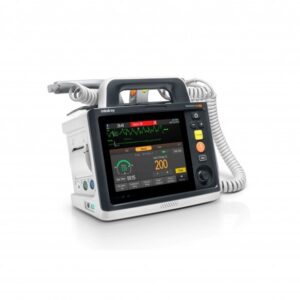
9-Inch Touch Display, 12-Lead ECG with MI Location Diagram, and 360J Biphasic Defibrillation
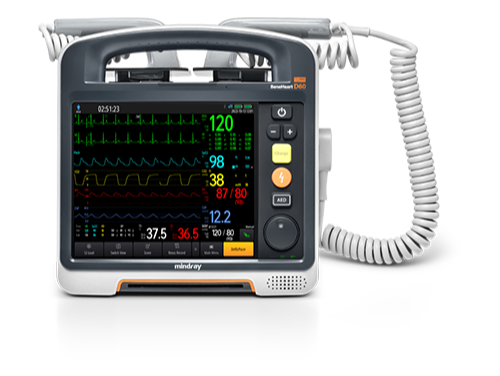
The Mindray BeneHeart D60 (VM-D60) is Mindray’s advanced portable defibrillator/monitor, designed for the full spectrum of resuscitation and monitoring environments — from pre-hospital EMS and air medical transport to emergency departments, ICUs, and high-dependency wards. The 9-inch LCD colour capacitive touch display — 1200×1020 pixel resolution, protected by tempered glass — renders up to 7 simultaneous waveform channels with gesture control, auto-brightness, high contrast mode, trace freeze, and screenshot capability, providing the information density required for simultaneous resuscitation and monitoring without navigation between screens. The 110mm wide-format thermal recorder prints up to 6 channels at speeds from 6.25 to 50mm/s, producing full-width clinical records including 12-lead analysis reports alongside real-time waveforms, rescue records, and event summaries. ECG monitoring covers 3-lead, 5-lead, and 12-lead configurations — with lead selection across all standard limb and precordial leads — and includes ST/QT monitoring, arrhythmia detection, and an MI location diagram that visually identifies the probable infarct territory on the 12-lead trace. This 12-lead diagnostic capability at point-of-care enables STEMI identification before arrival at the catheterisation laboratory, supporting pre-notification and door-to-balloon time reduction. Defibrillation is delivered as biphasic truncated exponential waveform with automatic impedance compensation, manual energy selection from 1–360J across 23 levels, charge to 200J in under 3 seconds and to 360J in under 7 seconds, and ECG signal recovery within 2.5 seconds of shock delivery. AED mode meets 2020 AHA and 2021 ERC guidelines by default, with configurable energy for adult (100–360J) and paediatric (10–200J) protocols.
Advanced Monitoring: IBP, Temperature, POCUS, SpO2, CO2, NIBP, CPR Feedback, and Clinical Scoring
The D60 integrates the complete monitoring parameter set required for advanced resuscitation and critical care transport. Beyond the ECG, SpO2, NIBP, sidestream CO2, and respiration parameters shared with the D30, the D60 adds dual-channel invasive blood pressure (IBP) monitoring (measurement range -50 to 360mmHg; sensitivity 5µV/V/mmHg), temperature monitoring for three parameters (T1, T2, TD; 0–50°C, 0.1°C resolution), and infrared ear temperature acquisition via NFC. SpO2 is compatible with Mindray, Nellcor, and Masimo protocols, preserving existing probe investment. The optional integrated point-of-care ultrasound (POCUS) uses a 2.0–4.0MHz phased array probe, supporting gain, depth, and TGC adjustment, image freeze and review, and guided step-by-step trauma assessment (FAST exam support with operation guide and reference images), with reporting, printing, and CMS transmission. CPR feedback monitors compression rate, depth, recoil, compression fraction (CCF), and Compression Quality Index (CQI) in real time. Clinical decision support is built into the device through integrated scoring tools: Glasgow Coma Scale (GCS and Paediatric GCS), National Early Warning Scores (NEWS, MEWS, NEWS2), HEART score for cardiac risk stratification, and a TBI warning system providing trend and warning prompts across SpO2, EtCO2, systolic blood pressure, and GCS score. These decision-support tools bring standardised early warning scoring to the point of patient contact — particularly relevant for pre-hospital and emergency department use — without requiring staff to perform manual calculations under time pressure.
MIL-STD-810G Rating, Dual Battery, 5G Connectivity, and Deployment in South Africa
The D60’s environmental durability exceeds standard medical device requirements. In addition to EN1789 shock and vibration compliance, it carries MIL-STD-810G vibration certification (helicopter category 14 and ground vehicle category 20) and RTCA-DO-160G aviation shock certification — confirming fitness for air medical transport and vehicle-mounted operation under sustained vibration loads. Free-fall rating is 1.5m on all 6 surfaces and 3.0m from normal operating position in carry case — the highest ruggedisation tier in the BeneHeart defibrillator range. The DC version accepts up to 2 × 4500mAh lithium-ion batteries, extending battery endurance for extended pre-hospital operations; the AC version accepts one battery. Each battery provides 6.5 hours of monitoring, 220 defibrillation shocks at 360J (at 1-minute intervals), or 4.5 hours of pacing per charge. Network connectivity covers Wired, Wi-Fi, 4G, 5G, and Bluetooth, with real-time patient data transmission to CMS or HL7 in-hospital, 4G/5G pre-hospital CMS transmission, and Bluetooth ePCR connectivity to third-party platforms via medical pad — enabling a continuous data record from first patient contact through hospital handover. Available in South Africa from Vital Medical, the VM-D60 is suited to advanced life support EMS services, air medical transport, emergency departments, ICUs, coronary care units, and any clinical setting requiring a fully ruggedised, diagnostically comprehensive defibrillator/monitor with POCUS capability and 5G connectivity.
TECHNICAL SPECIFICATIONS TABLE
| Specification | Detail |
|---|---|
| Brand | Mindray |
| Model | BeneHeart D60 |
| SKU | VM-D60 |
| Type | Defibrillator / Monitor |
| Dimensions (Paddle version) | 275 × 160 × 280mm (without external paddles) |
| Dimensions (Pad version) | 275 × 155 × 280mm |
| Weight (AC version) | 4.3kg |
| Weight (DC version, no paddle tray) | 3.9kg |
| Display | 9-inch LCD colour capacitive touch, tempered glass, 1200×1020px |
| Display Channels | Up to 7 simultaneous waveforms |
| Gesture Control | Yes |
| Defibrillation Waveform | Biphasic truncated exponential — with impedance compensation |
| Energy Range (Manual) | 1–360J (23 levels) |
| Charge Time | <3s to 200J; <7s to 360J |
| Power-On Time | <2 seconds |
| ECG Recovery Post-Shock | <2.5 seconds |
| Patient Impedance Range | 25–300Ω |
| Synchronous Cardioversion | Within 60ms of QRS peak |
| AED Mode | Yes — 2020 AHA / 2021 ERC; adult 100–360J; paediatric 10–200J |
| Noninvasive Pacing | Demand / fixed; 30–210ppm; 0–200mA; 20ms or 40ms pulse |
| ECG Leads | 3-lead, 5-lead, 12-lead |
| 12-Lead MI Location Diagram | Yes |
| ST/QT Monitoring | Yes |
| Arrhythmia Detection | Yes |
| SpO2 | Mindray (0–100%), Nellcor (0–100%), Masimo (1–100%) |
| NIBP | Manual, Auto, STAT, Sequence; Systolic/Diastolic/Mean |
| CO2 | Sidestream; 0–150mmHg; awRR 0–150rpm |
| Respiration | Trans-thoracic impedance; 0–200rpm |
| Temperature | T1, T2, TD; 0–50°C; 0.1°C resolution; infrared ear via NFC |
| IBP | 2 channels; -50 to 360mmHg |
| Point-of-Care Ultrasound | Phased array; 2.0–4.0MHz; 260g probe |
| CPR Feedback | Rate, depth, recoil, CCF, CQI; metronome, countdown, filter |
| Clinical Scoring | GCS, P-GCS, NEWS, MEWS, NEWS2, HEART score; TBI warning |
| Battery | 4500mAh lithium-ion (DC: up to 2 batteries; AC: 1 battery) |
| Battery Life | 6.5h monitoring / 220 shocks at 360J / 4.5h pacing |
| Recorder | 110mm thermal; max 6 channels; 6.25–50mm/s |
| Internal Storage | 4GB |
| ECG Waveform Storage | 120 hours consecutive |
| Event Storage | Up to 1000 events per patient |
| Data Export | USB flash memory |
| Connectivity | Wired, Wi-Fi, 4G, 5G, Bluetooth |
| Water Resistance | IPX5 |
| Dust Resistance | IP5X |
| Free-Fall Rating | 1.5m (all surfaces); 3.0m with carry case |
| Vibration | MIL-STD-810G (helicopter Cat. 14; ground vehicle Cat. 20); EN1789 |
| Aviation Shock | RTCA-DO-160G-2010 Section 7 |
| Operating Temperature | -20°C to +55°C |
| Operating Altitude | -382m to +4575m |
| Certifications | EN/IEC 60601-1; IEC60601-1-2 (EMC); IEC 60601-2-4 |