Manual Defibrillation to 360J, AED Mode, and Synchronous Cardioversion in a 2.8kg Unit
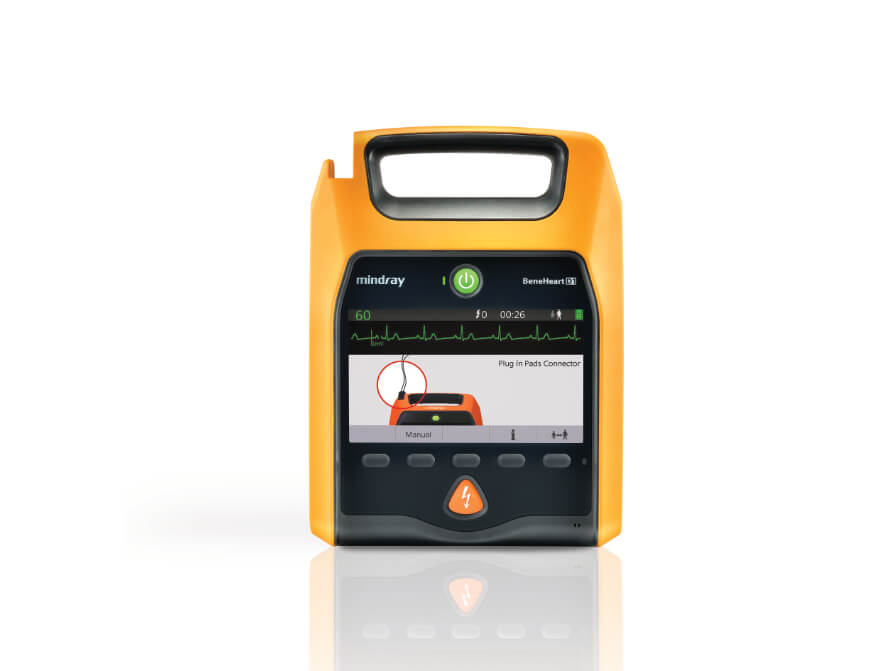
The Mindray BeneHeart D1 Pro (VM-D1) is a professional-grade portable defibrillator combining AED-mode rhythm analysis and shock delivery with clinician-controlled manual defibrillation and synchronous cardioversion — in a form factor of 210×286×79.5mm and 2.8kg including battery. This combination makes the D1 Pro deployable across the full range of professional emergency cardiac care environments: advanced life support EMS services, emergency departments, urgent care centres, general ward crash trolleys, and clinic emergency response kits. Defibrillation is delivered as biphasic truncated exponential (BTE) waveform with automatic impedance compensation across a patient impedance range of 25–200Ω, maintaining consistent effective energy delivery across the range of transthoracic resistances encountered in clinical practice. Manual mode gives the clinician direct energy selection across 21 levels from 1J through 360J (1, 2, 3, 4, 5, 6, 7, 8, 9, 10, 15, 20, 30, 50, 70, 100, 150, 170, 200, 300, 360J), with charge to 200J in under 5 seconds and to 360J in under 8 seconds from a fully charged battery. Synchronous cardioversion delivers energy within 60ms of the QRS peak, meeting the clinical requirement for safe conversion of haemodynamically unstable supraventricular tachyarrhythmias and VT with a pulse. AED mode defaults to 2015 AHA/ERC guideline-compliant energy protocols — adult 200J/300J/360J; paediatric 50J/70J/100J — with adult and paediatric energy fully configurable from 100–360J and 10–100J respectively, in 1, 2, or 3 shock series. The quick shock feature completes rhythm analysis and charging in under 8 seconds from the end of the “Stop CPR” prompt, minimising the no-flow interval during resuscitation.
3-Lead ECG Monitoring, Arrhythmia Alarms, and 7-Inch Display
The D1 Pro’s 3-lead ECG monitoring function supports lead selection across I, II, III, and PADS, displaying a continuous waveform on the 7-inch TFT colour LCD (800×480px) with a 6-second viewing window. Heart rate display covers adult (15–300bpm) and paediatric (15–350bpm) ranges at 1bpm resolution. The arrhythmia alarm library covers asystole, shockable rhythm, ventricular tachycardia, ventricular fibrillation, ventricular bradycardia, extreme tachycardia and bradycardia, PVCs (too high, nonsustained VT, multiform, couplet, bigeminy, trigeminy, RONT), ventricular rhythm, PNP, PNC, irregular HR across leads I, II, and III — providing continuous rhythm surveillance with automatic alarm generation without requiring the operator to maintain continuous visual waveform monitoring. ECG size is adjustable from ×0.125 to ×4 (AUTO through 40mm/mV); fixed sweep speed is 25mm/s. The display presents rhythm, heart rate, energy selection, and device status on a single screen, with no mode navigation required during resuscitation. The automated daily self-test runs without staff involvement, checks internal circuitry, the energy charging and delivery system, pads, and battery, and communicates device readiness through a continuous blinking green LED — confirming operational status at a glance from across the room — or a blinking red LED and audible alert when maintenance attention is required.
Dual Battery System, Ruggedisation, and Deployment in South Africa
The D1 Pro accepts two battery types: the rechargeable 3000mAh 14.8V lithium-ion pack (fully charged in under 3 hours; 90% in under 2 hours; minimum 300 shocks at 200J or 200 shocks at 360J per charge), and a disposable 4200mAh 12V Li/MnO₂ battery offering the same shock capacity with a 4-year standby life and 5-year pad shelf life. The disposable battery enables the D1 Pro to be deployed and left in a ready state for years without recharging infrastructure — relevant for rural clinics, remote community health posts, aircraft, and mine site medical stations where reliable mains power for recharging cannot be assured. The D1 Pro meets MIL-STD-810G shock (Method 516.6) and vibration (Method 514.6) standards and EN1789 road ambulance device requirements, with bump and free-fall ratings to EN1789 (0.75m) and IEC60068-2-32 (1.5m). IPX5 water and IP5X dust ingress protection provide reliability in outdoor, ambulance, and clinical cleaning environments. Data storage covers 1000 events, 8 hours of consecutive ECG waveform, and 3 hours of voice recording, with USB flash memory export for case review and documentation. Available in South Africa from Vital Medical, the VM-D1 Pro is suited to EMS advanced life support services, emergency departments, urgent care centres, rural and remote clinic emergency response, and any professional clinical environment requiring a compact, ruggedised, full-function defibrillator with manual override and ECG monitoring.
TECHNICAL SPECIFICATIONS TABLE
| Specification | Detail |
|---|---|
| Brand | Mindray |
| Model | BeneHeart D1 Pro |
| SKU | VM-D1 |
| Type | Professional Defibrillator — AED + Manual + ECG |
| Dimensions | 210 × 286 × 79.5mm |
| Weight | 2.8kg (with battery) |
| Display | 7-inch TFT colour LCD — 800×480px; 1 channel; 6s wave viewing |
| Defibrillation Waveform | Biphasic truncated exponential — with impedance compensation |
| Energy Accuracy | ±2J or 15%, whichever is greater |
| Patient Impedance Range | 25–200Ω |
| Manual Mode Energy | 1–360J — 21 selectable levels |
| Charge Time | <5s to 200J; <8s to 360J |
| Synchronous Cardioversion | Within 60ms of QRS peak |
| AED Mode — Adult Energy | 100–360J (configurable); default: 200J / 300J / 360J |
| AED Mode — Paediatric Energy | 10–100J (configurable); default: 50J / 70J / 100J |
| AED Shock Series | 1, 2, or 3 (configurable) |
| AED Guidelines | 2015 AHA / ERC |
| Quick Shock | Analyses and charges in <8s from “Stop CPR” prompt |
| ECG Leads | 3-lead + PADS; leads I, II, III, Pads |
| Heart Rate — Adult | 15–300bpm |
| Heart Rate — Paediatric | 15–350bpm |
| Arrhythmia Alarms | VF, shockable rhythm, VT, extreme brady/tachycardia, PVCs, irregular HR, and more |
| ECG Sweep Speed | 25mm/s |
| Rechargeable Battery | 3000mAh 14.8V Li-ion — min 300× 200J / 200× 360J; <3h full charge |
| Disposable Battery | 4200mAh 12V Li/MnO₂ — same capacity; 4yr standby; 5yr shelf life |
| Automated Self-Test | Daily — circuitry, charge/delivery system, pads, battery |
| Status Indicator | Green LED = ready; Red LED / audible alert = maintenance required |
| Adult Pad Surface Area | 83cm² each |
| Paediatric Pad Surface Area | 43cm² each |
| Pad Cable Length | 210cm |
| Pad Use-by | 36 months from manufacture |
| Data Storage | 1000 events; 8h ECG waveform; 3h voice recording |
| Data Export | USB flash memory |
| Water Resistance | IPX5 |
| Dust Resistance | IP5X |
| Operating Temperature | 0°C to +50°C |
| Storage Temperature | -30°C to +70°C |
| Operating Altitude | -381m to +4575m |
| Shock & Vibration | MIL-STD-810G (Method 516.6, 514.6); EN1789 |
| Free Fall | EN1789 (0.75m); IEC60068-2-32 (1.5m) |
| Safety | EN/IEC 60601-1 |