The 128Hz Standard for Clinical Vibration Sense Testing
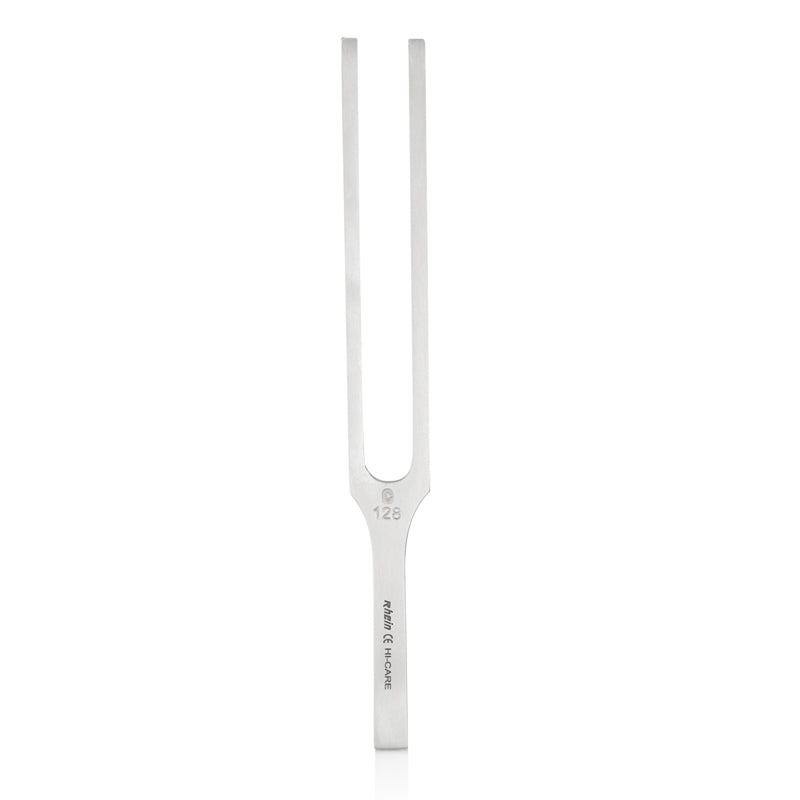
The 128Hz Tuning Fork (VM-TUN128) is a precision-machined aluminium alloy instrument designed for clinical assessment of vibration sensation and proprioception as part of the standard neurological examination. When struck firmly on the palm of the hand or a rubber surface and placed on a bony prominence — the great toe, medial malleolus, patella, tibia, or sternum — the VM-TUN128 transmits a sustained 128Hz vibration that the patient should be able to perceive. The clinician assesses whether the patient detects onset and cessation of the vibration, and compares perception at distal versus proximal sites to identify sensory deficits and map their distribution. The 128Hz frequency is the clinical standard recommended in neurological examination guidelines for vibration testing, distinguishing it from higher-frequency forks (512Hz and 256Hz) used primarily for auditory testing.
Peripheral Neuropathy Screening and Diabetic Foot Assessment
Loss of vibration sensation at 128Hz is one of the earliest and most sensitive indicators of large-fibre peripheral neuropathy — the fibre type responsible for vibration, proprioception, and light touch. In diabetic patients, impaired vibration detection at the great toe or medial malleolus is a primary risk marker for foot ulceration and a standard component of the annual diabetic foot screening examination recommended in clinical diabetes management guidelines. The VM-TUN128 is consequently used across diabetes clinics, general practice settings, community health centres, and hospital outpatient departments for routine foot screening, as well as in neurology wards and rehabilitation settings for post-stroke, spinal cord injury, and peripheral nerve injury assessments. Physiotherapists use it additionally to monitor sensory recovery following peripheral nerve repair.
Construction, Technique, and Clinical Availability
The VM-TUN128 is manufactured from aluminium alloy without added weights, allowing the prongs to vibrate at a pure, stable 128Hz frequency with minimal harmonic distortion. The 165mm length provides practical handling and accurate placement on bony landmarks during examination. Correct technique requires a firm strike to activate adequate vibration amplitude, followed by immediate placement on the test site — the patient’s ability to detect both the onset and extinction of vibration is assessed. Between patients, the instrument is cleaned with a 70% isopropyl alcohol (IPA) wipe. Available in South Africa from Vital Medical, the VM-TUN128 is a standard clinical instrument for neurology, general practice, and diabetes care settings requiring reliable, low-maintenance vibration sensation assessment.
Technical Specifications
| Specification | Value |
|---|---|
| VM SKU | VM-TUN128 |
| Frequency | 128Hz |
| Length | 165mm |
| Weights | None |
| Material | Aluminium alloy |
| Primary use | Vibration sensation and proprioception testing |
| Secondary use | Diabetic foot screening, peripheral neuropathy assessment |
| Cleaning | 70% IPA wipe |